
/
Events
/
Lectures
Unlocking the Schematismus
A machine learning and data-driven approach to Habsburg history

This work by Wolfgang Göderle is licensed under Creative Commons Attribution-NonCommercial-ShareAlike 4.0 International
Files (2)
Description
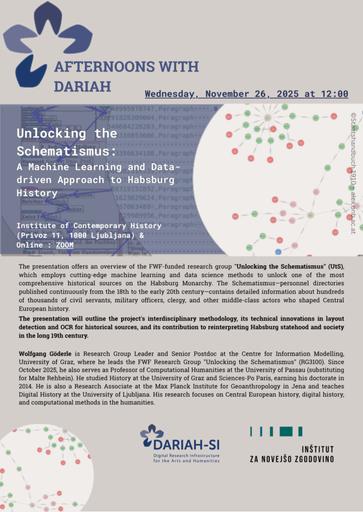
This presentation offers an overview of the FWF-funded research group “Unlocking the Schematismus” (UtS), which employs cutting-edge machine learning and data science methods to unlock one of the most comprehensive historical sources on the Habsburg Monarchy. The Schematismus—personnel directories published continuously from the 18th to the early 20th century—contains detailed information about hundreds of thousands of civil servants, military officers, clergy, and other middle-class actors who shaped Central European history.
The research group brings together historians, digital humanists, and data scientists from the University of Graz, TU Graz, and the University of Vienna in an ambitious five-year endeavour. The project pursues three key objectives: developing novel machine learning methods for extracting structured information from complex historical documents; creating a comprehensive semantic knowledge graph to represent and visualize this data; and producing new, data-driven historical insights into the Habsburg middle classes, social mobility, institutional evolution, and the transimperial dimensions of the monarchy.
This presentation will outline the project’s interdisciplinary methodology, its technical innovations in layout detection and OCR for historical sources, and its contribution to reinterpreting Habsburg statehood and society in the long 19th century.
Metadata (11)
- identifierhttps://hdl.handle.net/11686/71546
- title
- Unlocking the Schematismus
- A machine learning and data-driven approach to Habsburg history
- creator
- Wolfgang Göderle
- contributor
- Neja Blaj Hribar (mod.)
- Sergej Škofljanec (snem., ton. mojst.)
- Robert Vurušič (snem., ton. mojst., film. mont.)
- subject
- digitalna zgodovina
- OCR
- digitalizacija
- zgodovinski viri
- 19. stoletje
- description
- V okviru dogodka Popoldnevi z DARIAH smo gostili dr. Wolfganga Göderleja z Univerze v Gradcu, ki je predstavil delo na projektu “Unlocking the Schematismus“. V predavanju je bila poudarjena interdisciplinarna metodologija projekta, tehnične inovacije na področju zaznavanja postavitve in optičnega prepoznavanja znakov (OCR) za zgodovinske vire ter prispevek k ponovni interpretaciji habsburške države in družbe v dolgem 19. stoletju.
- This presentation offers an overview of the FWF-funded research group “Unlocking the Schematismus” (UtS), which employs cutting-edge machine learning and data science methods to unlock one of the most comprehensive historical sources on the Habsburg Monarchy. The Schematismus—personnel directories published continuously from the 18th to the early 20th century—contains detailed information about hundreds of thousands of civil servants, military officers, clergy, and other middle-class actors who shaped Central European history.The research group brings together historians, digital humanists, and data scientists from the University of Graz, TU Graz, and the University of Vienna in an ambitious five-year endeavour. The project pursues three key objectives: developing novel machine learning methods for extracting structured information from complex historical documents; creating a comprehensive semantic knowledge graph to represent and visualize this data; and producing new, data-driven historical insights into the Habsburg middle classes, social mobility, institutional evolution, and the transimperial dimensions of the monarchy.This presentation will outline the project’s interdisciplinary methodology, its technical innovations in layout detection and OCR for historical sources, and its contribution to reinterpreting Habsburg statehood and society in the long 19th century.
- publisher
- Inštitut za novejšo zgodovino
- date
- 26. 11. 2025
- type
- video
- language
- Angleščina
- rights
- license: ccByNcSa