
/
Events
/
Conferences
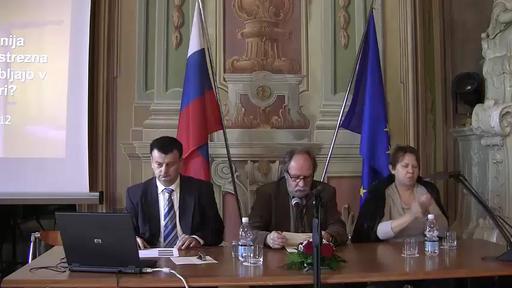
Repression of the Nazi Regime against Slovenians in the Austrian Styria 1938–1941
Author(s):Christian Promitzer
Leto:2012
Publisher(s):Inštitut za novejšo zgodovino/Institute of Contemporary History, Ljubljana
Language(s):slovenščina
Type(s) of material:moving image
Files (1)
Description
If we refer to Slovenians in the Austrian Styria, we have the following people in mind:
1. the autochthonous Slovenian-speaking population near the border with Yugoslavia in five villages in the Radgonski kot area – in the municipalities of Klanjci (German: Glanz) and Gradišče (Schlossberg), near the borough of Lučane, and in the municipalities of Radvanje (Rothwein) and Mlake (Laaken) near Sobota (Soboth) in the southeast of Austrian Styria;
2. Slovenian immigrants in Graz, whose roots date back to the second half of the 19th century.
Both groups had been under the pressure of the German national defence
societies Schulverein and Südmark ever since the end of World War I. In Graz Südmark watched closely the activities of the Slovenian society Čitalnica, which was the last of once numerous Slovenian organisations in this city that remained. The Slovenian-speaking population near the border was also monitored, and in the 1920s the gendarmerie already started drawing up a register on the national conviction of individual people.
By the time when the Nazis assumed the power after the Anschluss (annexation) of March 1938, the terrain had already been prepared for further measures for the national homogenisation of the former Austrian Styrian population. Before they resorted to direct repression, the new authorities wanted to find out as much as possible about the potential enemies. To this end, in the summer of 1938 in the Klanjci municipality the Nazi students from Graz researched the national structure of the local population and its influence on the potential conquest of Lower Styria. Their evaluation was negative, therefore they called for the »elimination of lesser human material« from these area. Also in Graz the Na- zis initially wanted to establish how many Slovenians lived in the city, so they carried out a public census. The Čitalnica society could keep working at first. It only had to adopt a new statute, prescribing a strict hierarchy (»Führerprinzip«). However, in 1940 the Gestapo arrested, interrogated and deported the secretary of this society, student Danilo Pirc, while the society itself was abolished shortly before the attack against Yugoslavia began. Perhaps the conquest of the eastern Slovenia saved the local Slovenian-speaking population near what had until then been the border from exile, since in the Slovenian (Lower) Styria the Nazis came across a more fertile area for the implementation of their denationalisation policy.
Metadata (9)
- identifierhttps://hdl.handle.net/11686/14260
- title
- Represija nacističnega režima nad Slovenci na avstrijskem Štajerskem 1938–1941
- Repression of the Nazi Regime against Slovenians in the Austrian Styria 1938–1941
- creator
- Christian Promitzer
- description
- If we refer to Slovenians in the Austrian Styria, we have the following people in mind: 1. the autochthonous Slovenian-speaking population near the border with Yugoslavia in five villages in the Radgonski kot area – in the municipalities of Klanjci (German: Glanz) and Gradišče (Schlossberg), near the borough of Lučane, and in the municipalities of Radvanje (Rothwein) and Mlake (Laaken) near Sobota (Soboth) in the southeast of Austrian Styria; 2. Slovenian immigrants in Graz, whose roots date back to the second half of the 19th century. Both groups had been under the pressure of the German national defence societies Schulverein and Südmark ever since the end of World War I. In Graz Südmark watched closely the activities of the Slovenian society Čitalnica, which was the last of once numerous Slovenian organisations in this city that remained. The Slovenian-speaking population near the border was also monitored, and in the 1920s the gendarmerie already started drawing up a register on the national conviction of individual people. By the time when the Nazis assumed the power after the Anschluss (annexation) of March 1938, the terrain had already been prepared for further measures for the national homogenisation of the former Austrian Styrian population. Before they resorted to direct repression, the new authorities wanted to find out as much as possible about the potential enemies. To this end, in the summer of 1938 in the Klanjci municipality the Nazi students from Graz researched the national structure of the local population and its influence on the potential conquest of Lower Styria. Their evaluation was negative, therefore they called for the »elimination of lesser human material« from these area. Also in Graz the Na- zis initially wanted to establish how many Slovenians lived in the city, so they carried out a public census. The Čitalnica society could keep working at first. It only had to adopt a new statute, prescribing a strict hierarchy (»Führerprinzip«). However, in 1940 the Gestapo arrested, interrogated and deported the secretary of this society, student Danilo Pirc, while the society itself was abolished shortly before the attack against Yugoslavia began. Perhaps the conquest of the eastern Slovenia saved the local Slovenian-speaking population near what had until then been the border from exile, since in the Slovenian (Lower) Styria the Nazis came across a more fertile area for the implementation of their denationalisation policy.
- Če govorimo o Slovencih na avstrijskem Štajerskem, pri tem mislimo: 1. na avtohtono slovensko govoreče prebivalstvo ob meji z Jugoslavijo, in sicer v petih vaseh Radgonskega kota, v občinah Klanjci (nem. Glanz) in Gradišče (Schlossberg) pri trgu Lučane ter v občinah Radvanje (Rothwein) in Mlake (Laaken) v okolici kraja Sobota (Soboth) na jugozahodu avstrijske Štajerske; 2. na slovenske priseljenke in priseljence v Gradcu, katerih korenine segajo nazaj do druge polovice 19. stoletja. Obe skupini sta bili že od konca prve svetovne vojne pod pritiskom nemško-nacionalnih obrambnih društev Schulverein in Südmark. V Gradcu je Südmark natančno opazoval delovanje slovenskega društva Čitalnica, ki je kot edino ostalo od nekoč številnih slovenskih organizacij v mestu. Nadzorovali so tudi slovensko govoreče prebivalstvo ob meji, kjer je žandarmerija že v dvajsetih letih izdelovala kataster o narodnem prepričanju posameznikov. Ko so nacisti po Anšlusu marca 1938 prevzeli oblast, so bila tla že pripravljena za nadaljnje ukrepe za narodno homogenizacijo prebivalstva nekdanje avstrijske Štajerske. Preden je uporabila neposredno represijo, je nova oblast hotela zvedeti čim več o morebitnih sovražnikih. S tem namenom so nacistični študenti iz Gradca poleti 1938 v občini Klanjci raziskovali narodno sestavo lokalnega prebivalstva in njegov vpliv na morebitno osvajanje Spodnje Štajerske. Njihova ocena je bila negativna, in so zato zahtevali »umik manjvrednega ljudskega materiala« iz teh krajev. Tudi v Gradcu so nacisti najprej hoteli ugotoviti, koliko Slovencev živi v mestu in pri tem uporabili ljudsko štetje. Čitalnico so sprva pustili delovati, morala je samo prevzeti nov statut, ki je predpisoval strogo hierarhijo (»Führerprinzip«). Leta 1940 pa je Gestapo aretiral, zaslišal in izgnal tajnika društva študenta Danila Pirca, medtem ko je društvo prenehalo delovati malo pred napadom na Jugoslavijo. Morda je osvojitev vzhodne Slovenije rešila lokalno slovensko govoreče prebivalstvo ob dotedanji meji pred tem, da bi ga izgnali, saj so nacisti našli na slovenskem (Spodnjem) Štajerskem bolj bogato področje delovanja za svojo raznarodovalno politiko.
- publisher
- Inštitut za novejšo zgodovino/Institute of Contemporary History
- date
- 2012
- 07. 11. 2012
- type
- video
- language
- Slovenščina
- isPartOf